
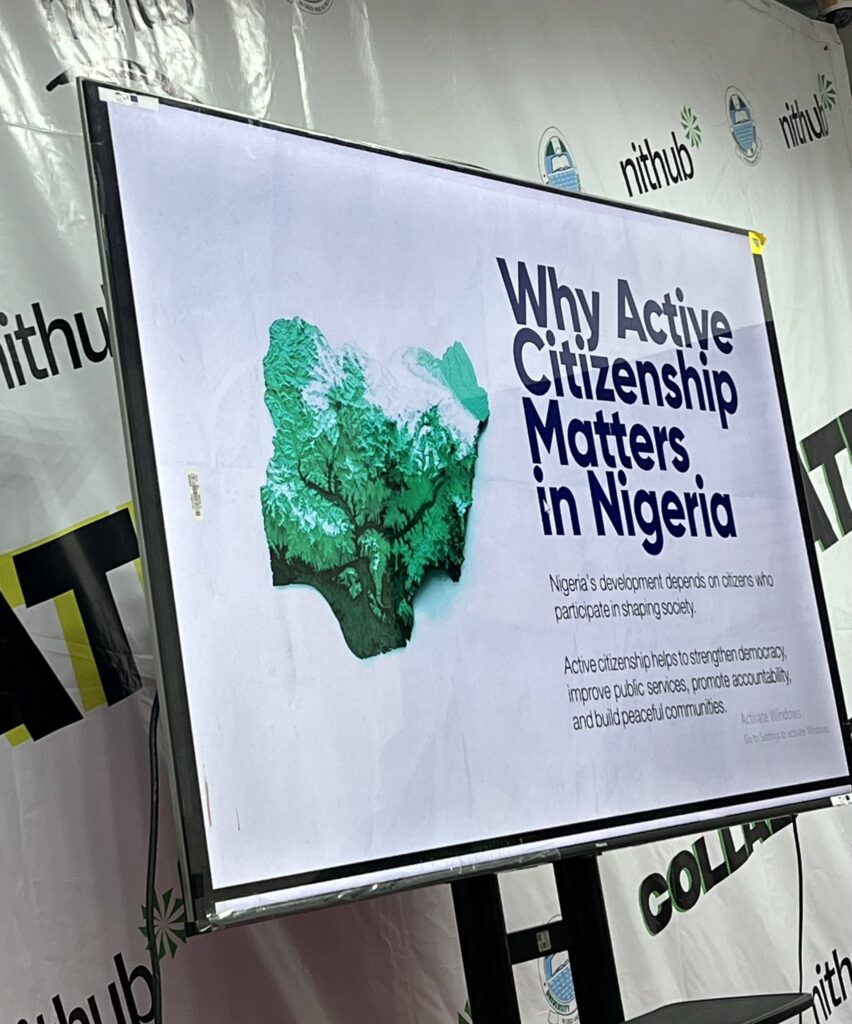
University students are far more than a demographic of learners; they are a strategic reservoir of national disruption and progress. Academically sound and driven by the pursuit of prestigious degrees, they possess a latent capacity to challenge entrenched cultural and religious paradigms. On June 3, 2026, at NitHub, University of Lagos, I stood before the National Association of Political Science Students (NAPSS) during their “PoliDriven” convention.
To ease these bright minds into a heavy discourse on national identity, I began the session with Timi Dakolo’s “Great Nation” playing through the speakers. The music served a strategic purpose: to soften the atmosphere before dissecting the hard truths of the Nigerian state. While the students’ academic drive was evident, the session revealed a critical need to transition them from passive recipients of a degree to active participants in the Nigerian narrative, moving beyond personal success toward national transformation.
The Identity Paradox: Navigating the 1914 vs. 1960 Narrative
Understanding a nation’s administrative origins is vital to effective governance and civic identity. In my interaction with the NAPSS students, I found a troubling disconnect: while most knew the date of the 1914 Amalgamation, they viewed it as a historical milestone rather than what it truly was—a British administrative tool. It was a matter of colonial convenience, not a covenant of nation-building. This distinction is critical; a country designed for the ease of its colonisers often lacks the inherent DNA required for a functional, unified state.
Is Nigeria truly independent, and is the current state of the country reflective of how a functional state should be?
As I posed this question, I looked at the students and felt they seemed even younger than I did during my own first years at university. Memories of my own “innocent approach” to politics flooded back, yet I realised these “digital era” students are strategically sophisticated in ways my generation was not. They have unprecedented access to rapid information, data, and research. However, this increased political perception remains a theoretical exercise until it is applied to the immediate, practical challenges that define their daily lives.

Case Study in Crisis: The UNILAG Housing Deficit
Local issues serve as a microcosm for broader national governance failures. At the University of Lagos, the accommodation crisis is a stark indictment of the gap between policy and reality. When institutional infrastructure fails to scale with the population, it creates a survivalist environment that stifles collective civic engagement.
The UNILAG Accommodation Gap
| Category | Data / Impact |
| Total Student Population | 52,000 |
| Available Public Bed Spaces | 8,000 – 12,000 |
| Impact | Forced reliance on “squatting,” cramped hostels, and overpriced private housing. |
The transparency deficit is best illustrated by the N1.6 billion “Landmark Student Hostel.” Officially titled the “Construction and Furnishing of a 484-bed Landmark Student Hostel,” this project was a publicly funded zonal intervention. However, the “So What?” lies in the optics: it was allegedly passed off as a personal donation to the university by the former Speaker of the House of Representatives, Femi Gbajabiamila.
Despite the massive public allocation, the facility remains largely out of reach for the average student. This controversy, paired with the fear of backlash from university authorities or the police, has shifted student activism from the vibrant, collective movements of the 80s and 90s to restricted, individual efforts.
Redefining the Active Citizen: A Framework for Responsibility
Active citizenship is not a static title conferred upon graduation; it is a continuous, rigorous practice essential for the health of a democracy. It is the refusal to remain a spectator while the machinery of state rusts.
To be an Active Citizen is to adopt a framework of responsibility defined by:
- Informed Engagement: In an era where falsehoods go viral, an active citizen prioritizes fact-checking and authentic information over emotional agitation.
- Civic Participation: This extends beyond the ballot box to include volunteering time and professional skills to improve local communities.
- Accountability: Proactively holding leaders to account rather than waiting for “someone else” to speak up.
- Solution-Oriented: A refusal to wait for permission to act, choosing instead to contribute directly to solving the problems identified.
This practice is the only viable pathway to building a Nigeria that students can be proud of. However, theory without tools is merely noise.
The Strategic Toolkit: CivicTech and Electoral Power
Technology is the force multiplier for the active citizen, reducing the margins for electoral fraud and fiscal opacity. By integrating CivicTech into their advocacy, students can transform their digital sophistication into tangible political power.
CivicTech Resources for Impact:
- Electoral Integrity: Beyond PVC registration for 2027, students must document the Polling Unit (PU) experience. By posting PU results online, citizens create an alternative tabulation that can be matched against the iRev portal. This creates a data-backed deterrent against fraud during the collation process.
- Fiscal Transparency: Use Budgit (me.budgit.org) and Govspend.ng to track actual government expenditures. Supplement this with Tracka.ng to report and monitor community-level project execution.
- Advocacy & Rights: Leverage Gavel.ng for free legal support regarding human rights abuses and EiE.org to find and contact elected representatives directly.
The upcoming West Africa CivicTech Conference (July 24, 2026) and engagement with CivicHive offer immediate platforms for students to master these tools. Technology ensures that the voice of the youth is not just loud, but impossible to ignore.

A Mandate for the “Greatest Omo’ Politico”
The journey from a degree-seeker to a nation-builder requires a synthesis of personal reflection and strategic action. My time at NitHub confirmed that while individual academic success is vital, it cannot replace the collective need for civic participation. To make a lasting impact, every student must commit to this four-point mandate:
- Understand the nuances of active citizenship and the mechanics of change making.
- Identify specific, localised opportunities to contribute to society.
- Influence positive change through practical, evidence-based advocacy.
- Develop a personal action plan that moves from theoretical knowledge to daily practice.
Active citizenship is not a title; it is a practice.
Every time you volunteer, fact-check, or track a public budget, you are laying a brick in the architecture of the Nigeria we deserve.
Greatest Omo’ Politico!
Joseph Amenaghawon is the Head at CivicHive.