
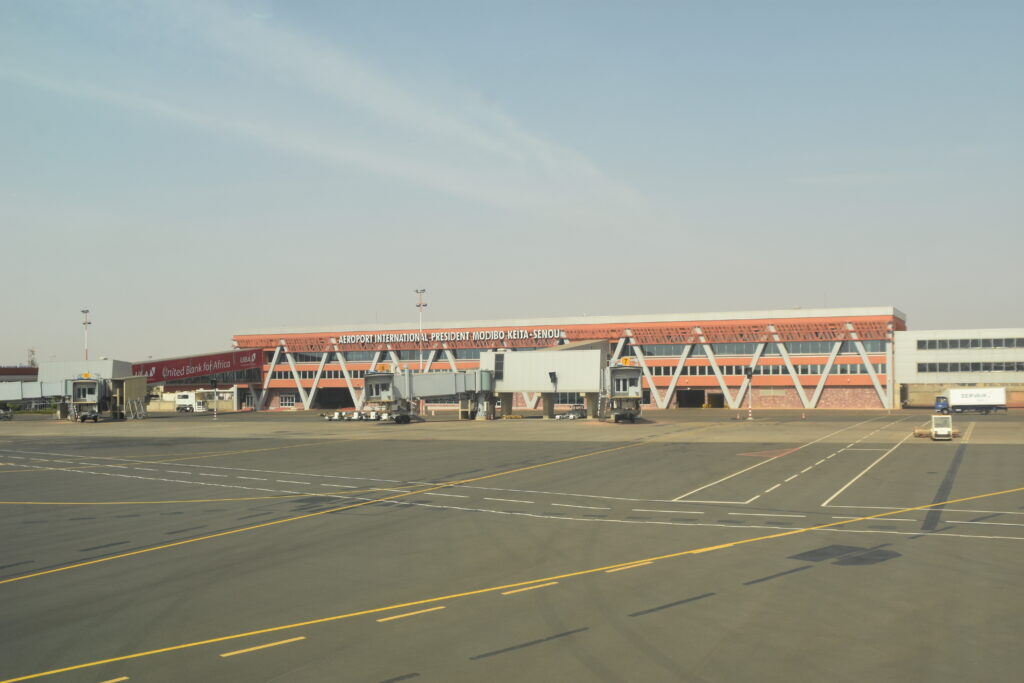
There are some places you visit and leave with pictures. Then there are places you leave with questions. Mali was the second kind for me.
I travelled to Bamako for the West Africa Civic Tech Network Training, hosted by Civic Hive in partnership with Tuwindi, focused on strengthening the efficiency and operational capacity of civil society organizations in Mali. On paper, it was a work trip, sessions, partner meetings, capacity-building, and community engagement. But what I encountered went beyond these conversations. It became a journey into history, politics, culture, and the quiet psychology of what it means to live in a country shaped by military rule.
As a Gen Z Nigerian, this was my first time visiting a military-led country, and I arrived with curiosity, caution, and honestly, a little bit of nervous excitement. The first thing that struck me was how normal everything looked. And that, somehow, was the most unsettling part; a country with a past.
To appreciate my observations of Bamako, one must first grasp the significance of what Mali truly embodies. The name Mali itself comes from the Mali Empire, one of the most powerful and wealthy empires in African history. It simply means “the place where the king lives,” carrying a sense of strength, royalty, and historical significance. Long before colonial borders, Mali was already central to West Africa’s political and economic life.

This land was once home to three great empires: the Ghana Empire, the Mali Empire, and the Songhai Empire. At its peak in the 14th century, the Mali Empire under Mansa Musa was considered one of the wealthiest empires in the world. Timbuktu, now often spoken about as myth, was once one of the greatest centers of learning, scholarship, and Islamic knowledge globally.
To stand in modern Mali knowing this history creates an almost surreal contrast. This is not just any country. This is a place layered with memory. A place where empire, trade, knowledge, colonialism, revolution, and modern governance all intersect.
Democracy, Coups, and the Long Road to Military Rule
Like many African states, Mali’s modern political journey is deeply shaped by colonialism and post-independence transitions. After gaining independence from France in 1960, Mali’s first president, Modibo Keïta, established a one-party socialist state. The democratic aspirations that accompanied independence quickly narrowed into centralized control. Then came the coups. Military intervention became a recurring part of the country’s political story.

From Moussa Traoré’s coup in 1968, to democratic restoration in the 1990s, to the more recent coups of 2020 and 2021 led by Assimi Goïta, Mali’s political history has been marked by repeated ruptures. What stood out to me while learning more about the country is how democracy in Mali was once regarded as one of the most stable in Africa. That part stayed with me. Because it reminds us that political decline is rarely sudden. It often happens in layers.
A crisis here, a conflict there, and a coup justified as temporary; then another. Until an entire generation begins to see military governance as normal, and that was one of the most haunting parts of our conversations during the training. For many young Malians, this is the only governance they know in real sense.
The Airport Moment That Changed My Mindset
The moment we landed in Bamako, I instinctively reached for my phone. The airport was beautiful in its own quiet way, and as someone who loves documenting places, I started taking pictures. Then someone walked up to me and said: “You should stop taking pictures.” Simple, not hostile, but enough to immediately shift something inside me. That moment made me suddenly aware that I was no longer just visiting another West African city. I was in a politically sensitive environment.
Following that encounter, my awareness sharpened; I began to meticulously study my surroundings, from the architecture and advertisements to every uniformed official.
What fascinated me most about Bamako was how oddly peaceful and orderly everything felt.
People moved with grace, citizens were going about their daily lives, buying food, commuting, working, chatting. On the surface, it looked completely normal. But there was a kind of social caution in the air. A quietness that felt less like fear and more like collective awareness. Almost as if everyone had learned how to exist without disrupting the fragile balance around them. Not tense, just careful. And honestly, that was one of the most powerful things to observe because sometimes political reality is not loud, sometimes it lives in silence.
Community Is Visible Here
Our visit to Tuwindi was one of the warmest parts of the trip. What stood out was how deeply communal everything felt. As our hosts walked us around, they kept introducing us to people in the neighborhood. Shop owners, neighbors, people passing by. It genuinely felt like everybody knew everybody, and the moment you enter as a newcomer, people immediately notice. There was something incredibly human about that.

In a world where cities can often feel isolating, Bamako reminded me of what a community looks like when it is still fully alive. Another thing I could not stop noticing was the number of women riding scooters, everywhere. At first it surprised me, then it fascinated me. Compared to Nigeria, where this is less visible in many cities, it felt refreshing and distinct.
It was one of those everyday details that says a lot about movement, culture, and how public spaces are occupied.
The Hardest Conversation: Young People and Participation
The most powerful conversation during the training was around youth participation. Many young people in Mali are discouraged from civic engagement not necessarily because they do not care, but because this current political reality feels normal to them. If you have grown up mostly under military-led transitions, how do you even begin to imagine something different?

How do you convince young people that participation matters when they have never fully experienced accountable democratic systems? That conversation hit deeply, because it is not just a Mali question; it is a regional question. Across West Africa, many young people are negotiating disillusionment, distrust, and political fatigue. This is why the work of strengthening CSOs matters so much. Civil society becomes the bridge between resignation and possibility.
What I Left With
What stayed with me most from Mali was the realisation that civic participation can never be separated from the people it directly replays too and context. For many young people we engaged with, military-led governance is not an interruption to normal life, but the only reality they have known. This makes conversations around participation more complex, because before asking citizens to engage, there must first be space to help them imagine that their voices matter.
The quiet order of Bamako, the cautious way people move through public spaces, and the reflections from youth all reinforced how deeply systems shape everyday life and public consciousness. This is why the West Africa Civic Tech Network remains so important. The Network is building a stronger civic innovation ecosystem across the region by connecting civil society organisations, technologists, and young innovators to use technology for accountability and citizen engagement.

Through its hackathons, conferences, and regional convening. It has supported the development of tools like Observe West Africa , Open West Africa , and Know West Africa, all designed to make governance information, civic education, and public accountability more accessible across the region. The Mali convening was a continuation of this vision: strengthening civic participation through community, collaboration, and practical tech solutions for West Africa.
For me, Mali was a reminder that change often begins quietly, and sometimes it starts in a training room, and a reminder that civic engagement cannot be one-size-fits-all.