
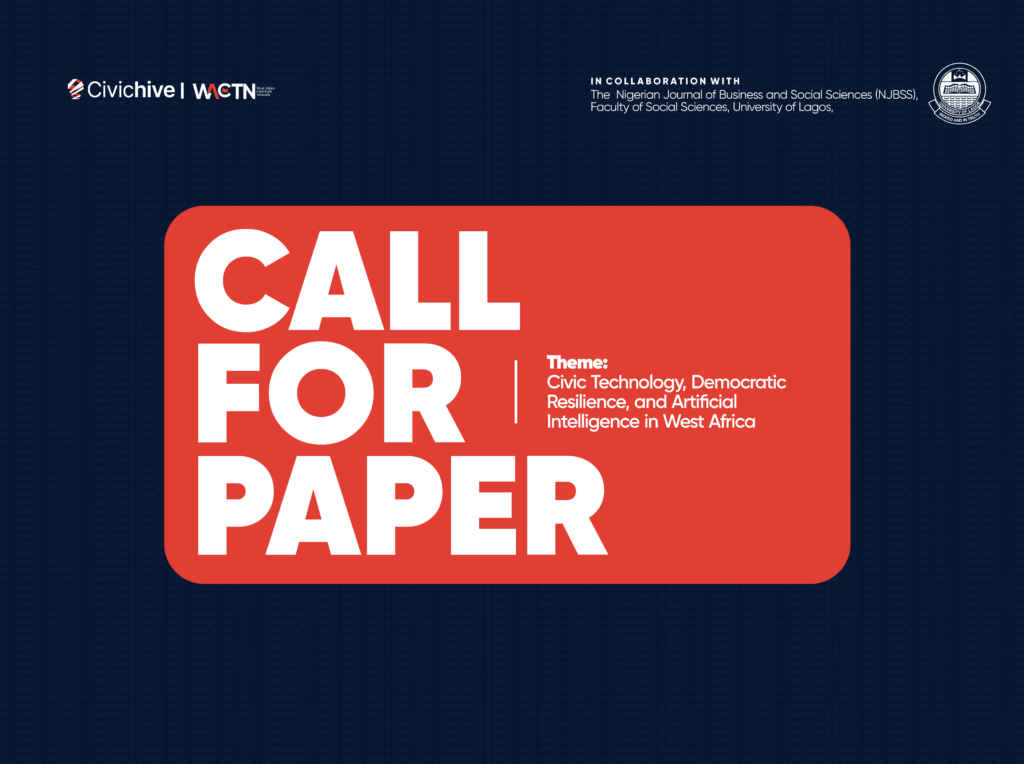
Across West Africa, civic technology has emerged as a powerful tool for advancing transparency, accountability, and citizen participation in governance; however, rising democratic challenges, shrinking civic spaces, the spread of misinformation, and the increasing use of Artificial Intelligence continue to raise critical questions about the role of technology in shaping governance and public discourse, and it is on this premise that the West Africa Civic Tech Network (WACTN), in collaboration with the Nigerian Journal of Business and Social Sciences (NJBSS), Faculty of Social Sciences, University of Lagos, invites scholars, researchers, and practitioners to submit evidence-based papers that explore the opportunities, risks, and future of civic technology within the region.
The Nigerian Journal of Business and Social Sciences is a publication of the Faculty of Social Sciences, University of Lagos, Nigeria. NJBSS is a peer review journal devoted to publishing issues. NJBSS invites high quality research papers for this 2026 special issue.
- Sub Themes (Areas of Submission)
We welcome submissions on, but not limited to, the following:
- Civic-Tech and Democratic Participation
– Tools and platforms enhancing citizen engagement in governance and public policy
– Civic tech applications in elections, transparency, and accountability
- Technology and Democratic Backsliding
– Use of digital tools to restrict civic space, suppress dissent, or control information in West Africa – Case studies from politically constrained or authoritarian contexts from West Africa
- Artificial Intelligence, Misinformation, and Governance
– AI in public decision-making, misinformation, surveillance, and electoral processes
– Algorithmic bias, data governance, and implications for civil liberties
– Regulatory gaps and policy responses to AI in West Africa
- Digital Rights and Civic Space
– Online freedoms, internet Shutdowns, data protection, and digital activism
– Strategies for safeguarding civic space in restrictive environments
- Innovation, Scalability, and Sustainability
– Models for scaling civic tech solutions across diverse contexts
– Financing mechanisms and ecosystem support structures
- Countering Autocratic Narratives
– Detection and mitigation of disinformation and propaganda
– Role of civic-tech in strengthening democratic narratives
Submission Guidelines
- Manuscripts should be typed in MS Word format
- Font: Times New Roman, Size 12
- Spacing: 1.5 line spacing
- Maximum length: 20 pages (including references)
- Language: All submissions must be written in English.
- Title (Font 14, Bold), Concise and clear. Capitalize only the first word and proper nouns.
- Author(s) Name(s) Font 12, Bold
- Author(s) Affiliation(s) Font 12, Normal but provide names and full institutional names and addresses.
- Abstract (250–300 words): Each submission must include an abstract summarizing the key arguments and findings.
- Main Body (Font-11-normal). The body of paper should be structured using clear headings and subheadings.
- Reference Style: References should follow APA 7th Edition citation style.
- Acknowledgment: The acknowledgment section follows the main body of the paper. Use a principal heading without a number.
- Conflict of Interest: Author(s) must declare if the paper is sponsored by a grant or any other related financial support.
- Mode of Submission: All manuscripts should be submitted via email: jbss@unilag.edu.ng, cc Research@civichive.org
For enquiries, contact: Dr Femi Aiyegbajeje: 08035514427, Arafat Oseni – 07081521899,