
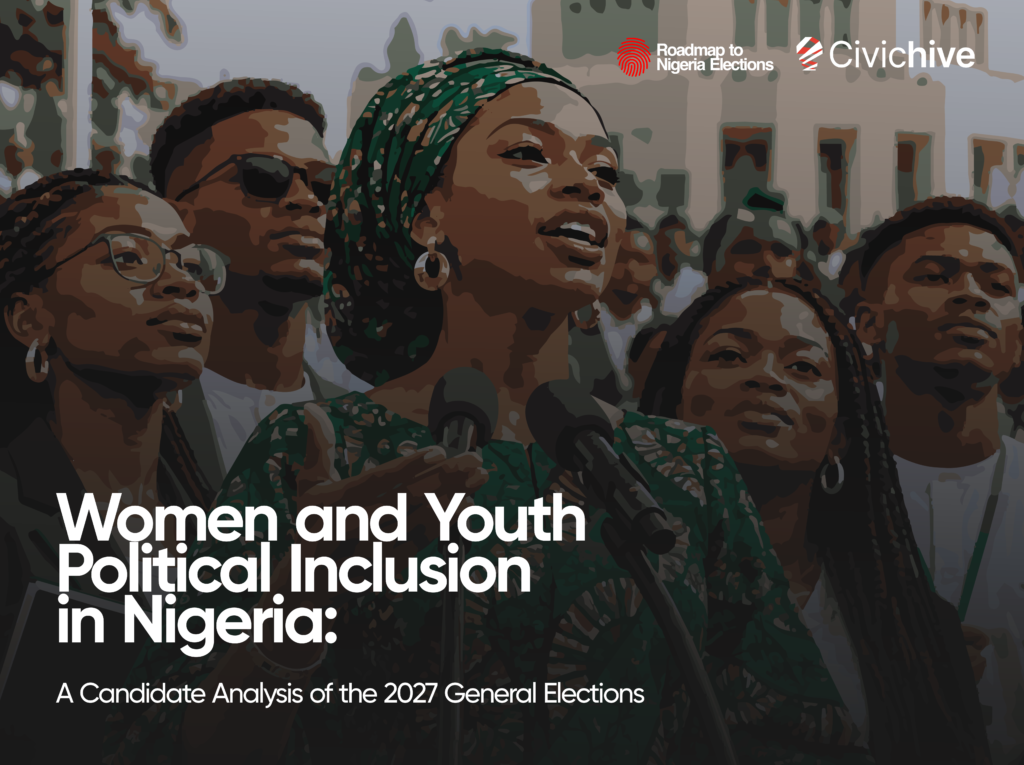
Civic Hive, a civic tech organisation committed to promoting open data and governance, citizen participation, and data transparency, has released its report, “Women and Youth Political Inclusion in Nigeria: A Candidate Analysis of the 2027 General Elections.”
The report presents a comprehensive analysis of official Independent National Electoral Commission (INEC) records across all 22 registered political parties and candidates vying for legislative positions in the 2027 General Elections. It examines the representation of women and young people in the electoral process, highlighting their participation across the Senate, House of Representatives and State Houses of Assembly, as well as the persistent barriers to their political inclusion and representation.
The findings from this report reveals that major political parties have failed to convert legal eligibility into viable candidacies. Instead, exorbitant party nomination fees, non-transparent party primaries, and deeply entrenched patronage systems continue to concentrate political power within older, male-dominated groups.
Key findings from the report are as follow
The Senate: Persistent Barriers to Youth and Women’s Representation
- Out of 1,303 total candidates vying for Senate seats across 36 states and the Federal Capital Territory (FCT), female candidates account for only 9.44% (123 candidates), while young candidates (aged 40 and under) account for 14.35% (187 candidates).
- Exactly 34 female candidates fall into the young candidate category (aged ≤ 40), representing 27.64% of all female candidates. This indicates that more than a quarter of women contesting for Senate seats entered the political arena early in their careers under the constitutional threshold created by the “Not Too Young To Run” legislation.
- Four states field zero female candidates across all political parties: Jigawa, Nasarawa, Niger, and Yobe. Meanwhile, Lagos State has 0 youth candidates, with Anambra and Abia nominating only a single youth candidate each.
- Northern states have the highest overall youth candidate counts led by Kano (122), Sokoto (72), and Kaduna (70), several registered total female youth exclusion: Borno, Katsina, and Yobe recorded zero young female candidates. Only Kwara (13.85%) and Cross River (12.70%) crossed the 10% threshold for young female candidacy.
House of Representatives: Young Women Remain Underrepresented
- 1,244 of the 3,560 House of Representatives candidates (34.94%) are aged 40 or younger. However, participation is heavily skewed toward the upper boundary: 60.9% (758 candidates) are between 35 and 40, while only 17 candidates nationwide entered at the constitutional minimum age of 25.
- Young women face near-total omission on major tickets. The APC nominated only 1 young female candidate across 360 federal constituencies nationwide (0.28%; Chiamaka Issac-Ojo in Rivers State). The PDP fielded just 8 (2.53%), while the ADC nominated none.
- Northern states have the highest overall youth candidate counts led by Kano (122), Sokoto (72), and Kaduna (70), several states registered total female youth exclusion: Borno, Katsina, and Yobe recorded zero young female candidates. Only Kwara (13.85%) and Cross River (12.70%) crossed the 10% threshold for young female candidacy.
State Assemblies: Growing Youth Candidacy, Persistent Gender Gaps
- State Houses of Assembly recorded the strongest youth involvement, with candidates aged 40 and under making up 45.44% (4,454 out of 9,802 candidates).
- Despite higher youth participation, female representation remains low at 10.30% (1,010 candidates) nationwide.
- Over half of all female assembly contestants (52.38% / 529 candidates) are aged 40 or younger, showing that the youth remains the single largest engine for female political entry.
- Yobe recorded 72.77% youth candidates but merely 1.41% female candidacy (3 women total). South-West and South-South states recorded the highest female representation, led by Kwara (21.59%), Osun (21.29%), and Ekiti (21.14%).
Speaking on the report, Joseph Amenaghawon, Head of CivicHive, said
Young people have always taken the initiative and led excellently when given the opportunity to do so. In colonial times, it seemed natural for them to take the lead in national affairs, just as young people populated the leadership of post-colonial rule, a typical example is Yakubu Gowon, who as young as 32 became the head of state in Nigeria. Yet today, while minor and emerging parties serve as the primary engines of demographic inclusion, Nigeria’s major parties lag behind in some cases shutting out young candidates and women entirely.
CivicHive recommends that political parties should move beyond promises to gender equality to introducing enforceable measures that increase women’s and youth participation in electoral contests. This inevitably will include reduced nomination fees, financial support, mentorship and leadership development programmes for female aspirants. Also, barriers that discourage Persons with Disabilities from elective office should be abolished at the very top. There should be quotas targeted for women, young people and persons with disabilities under which these targets must be monitored with every transparent reporting that disclose composition of candidates before primaries. It is therefore important that INEC, CSOs and other electoral stakeholders ensure that parties comply with these set targets.
Civic Hive remains committed to building a strong community of active citizens, strengthening institutions, promoting democratic principles, and advancing citizens’ participation in governance. As a non-partisan organisation, We believe that achieving meaningful political inclusion in Nigeria requires more than increasing the number of women, young people and persons with disabilities contesting elections, it demands institutional reforms that enable them to secure party nominations, compete fairly, win elections and exercise meaningful influence in governance.
To read the full report, kindly download using this link.