
The future of governance in West Africa will not be built by governments alone. It will be shaped by young people, innovators, civil society, policymakers, and communities willing to reimagine how technology can strengthen democracy. This belief is at the heart of the West Africa CivicTech Conference 2026, which convened more than 400 participants from nearly different countries in West Africa.
For two days, the conference became a meeting point for civic innovators, policymakers, civil society organisations, students, researchers, social entrepreneurs, development partners, and technology enthusiasts committed to one shared vision: building a more accountable, inclusive, and digitally enabled West Africa.
Centred on the theme, “Youth, Technology & the Future of Governance in West Africa,” this year’s conference explored one of the region’s most pressing questions: How can young people harness technology to shape governance systems that are transparent, participatory, and responsive to citizens’ needs? The conversations were timely. Across West Africa, young people are increasingly using technology not just to consume information but to organise communities, advocate for policy reforms, monitor elections, analyse public spending, and demand greater accountability from institutions. The conference reflected this growing momentum, creating a space where ideas could move beyond discussion and become pathways for collective action.

Why West Africa Needed This Conversation
The conference opened with a thought-provoking welcome address by Oluseun Onigbinde, Global Director of BudgIT, who set the tone for the conversations that would shape the conference. Reflecting on the vision behind the gathering, Oluseun Onigbinde explained that the conference was born out of a desire to strengthen the civic technology ecosystem across West Africa by creating a platform for peer learning, collaboration, and knowledge exchange. Through Civic Hive, BudgIT’s innovation hub, the aim is to bring together innovators, civil society organizations, policymakers, researchers, entrepreneurs, and technology enthusiasts from across the sub-region to share ideas, learn from one another, and co-create solutions to common governance challenges.
He emphasised that governance cannot be approached with a one-size-fits-all mindset, as every country has its own unique political, social, and institutional realities.
Governance is not like selling solar lanterns or bottles of beer. What works in Zambia doesn’t automatically work in Nigeria.
With this powerful analogy, he highlighted the importance of designing civic tech solutions that are rooted in local contexts rather than simply replicating models from other countries. While there is much to learn from one another across the region, sustainable civic innovation depends on adapting ideas to the realities of each society.
Oluseun Onigbinde also issued a powerful call to young people, reminding participants that with more than 70% of West Africa’s population under the age of 30, the region’s greatest opportunity for transforming governance lies in its youth. He challenged young innovators to see themselves not only as beneficiaries of good governance but as active contributors to building technology-driven solutions that promote transparency, accountability, and meaningful citizen participation. Recognising that no single organization can transform governance alone, he stressed the importance of collaboration, continuous learning, and cross-border partnerships. He encouraged civic actors to build solutions that are thoughtful, inclusive, and responsive to the realities of the communities they seek to serve, while also rethinking how civic technology initiatives are funded to ensure they remain sustainable beyond grants. Perhaps the most memorable takeaway from his address was his reflection on the place of civic technology within Africa’s broader innovation ecosystem.

We don’t talk about civic tech well enough.
While sectors such as fintech, health-tech, agrictech, food-tech, and the likes often dominate conversations around innovation, he argued that civic technology deserves equal attention because it provides the foundation upon which every other innovation depends. Without effective governance, active citizen participation, and public trust, even the most groundbreaking technology advancements struggle to deliver meaningful and lasting impact. As he noted, if governance fails, citizens lose trust, participation declines, and the environment that enables innovation begins to weaken.
His welcome address was more than an introduction to the conference, it was a compelling call for West Africa to invest in solutions, empower its young people, deepen regional collaboration, and place civic technology at the heart of conversations about the region’s future.
Understanding the Civic Tech Landscape in West Africa
Following the welcome address, Joseph Amenaghawon, Head of Civic Hive, presented key insights from West Africa CivicTech Landscape Report offering a snapshot of the region’s evolving civic tech ecosystem. He noted that while young people across West Africa are increasingly using digital tools and online platforms, an important question remains: Are we channeling this digital energy towards improving governance and civic tech environment?
Drawing on findings from the report, Joseph highlighted a growing digital safety gap. As civic organisations continue to use technology to promote transparency, accountability, and citizen engagement, they also face increasing cyber threats, weak data protection systems, and low levels of digital security awareness. The emergence of artificial intelligence has created new opportunities for civic action, but it has also introduced new risks that organisations must be prepared to navigate.
One of the report’s most striking findings revealed that seven out of ten civil society organisations have never received formal digital security training, while one in three organisations has experienced a cyberattack. These findings underscore the need to strengthen digital resilience across the civic tech ecosystem. Joseph also highlighted the West Africa CivicTech Network, an initiative by Civic Hive that fosters regional collaboration and has led to solutions such as Observe West Africa, a civic technology platform that supports election observation and promotes citizen participation across the sub-region.
For those interested in exploring these findings further, the West Africa CivicTech Landscape Report provides deeper insights into the opportunities and challenges shaping the future of civic technology in the region.

Driving the Conversations That Matter
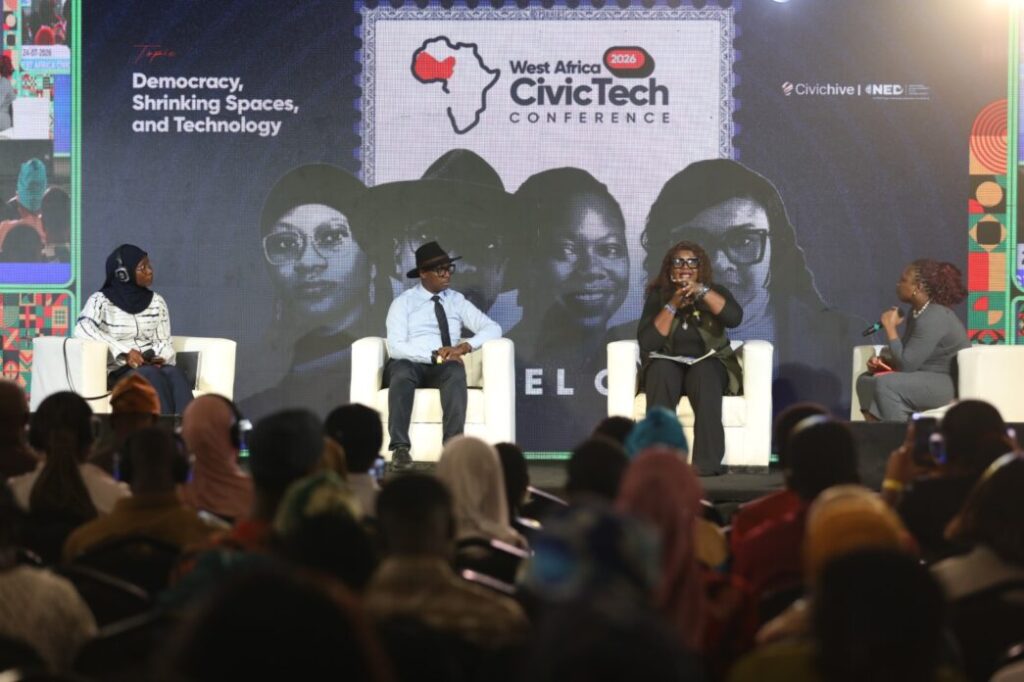
One of the defining strengths of this year’s conference was its willingness to engage in difficult but necessary conversations about the future of democracy, civic participation, and digital rights in West Africa. The first panel, “Democracy, Shrinking Spaces, and Technology,” explored how civic actors are responding to increasing restrictions on civic engagement while leveraging technology to organise communities, amplify citizens’ voices, and promote accountability.
One of the standout moments came from Mrs. Victoria, Executive Director, Spaces for Change, who reminded participants that meaningful transformation begins with access to information. She emphasised that “information that is not used is as good as unused,” explaining that knowledge only becomes valuable when it inspires action. Her message reinforced the role of informed citizens in driving social and political change. The session was highly interactive, with participants actively engaging the panelists through questions and discussions. One attendee asked for examples of meaningful change driven by young people. In response, the speakers pointed to movements such as #EndSARS, highlighting how youth-led advocacy has influenced conversations around police reform and governance. They also reminded the audience that lasting change is rarely immediate, noting that progress should not be measured in days or months but through the gradual transformation of institutions and public systems.
The second panel, “Military, Internet Shutdowns, Digital and Human Rights in West Africa,” examined the growing impact of internet shutdowns, political instability, and digital rights violations across the region. Panelists emphasised that protecting digital rights is fundamental to preserving civic freedoms and ensuring citizens can continue to participate meaningfully in democratic processes.
Together, the two sessions challenged participants to think beyond technology as a tool and consider its broader role in safeguarding democracy, protecting civic space, and empowering citizens across West Africa.