
The session on bridging digital rights, democratic trust, and citizen action at the West Africa Civic Tech Conference highlights the critical intersection of civic technology, digital rights, and democratic governance in the region. Discussions emphasise that while governments must address legitimate security concerns, heavy-handed measures like internet shutdowns, censorship, and unauthorised digital surveillance severely restrict freedom of expression.
Speakers from civil society and government stress the vital importance of empirical research, strategic litigation, and robust legal frameworks to protect activists and everyday citizens. Ultimately, fostering a healthier digital ecosystem requires proactive collaboration, adherence to international human rights standards, and building genuine trust between the public and state institutions.

- Military, Internet Shutdowns, Digital and Human Rights
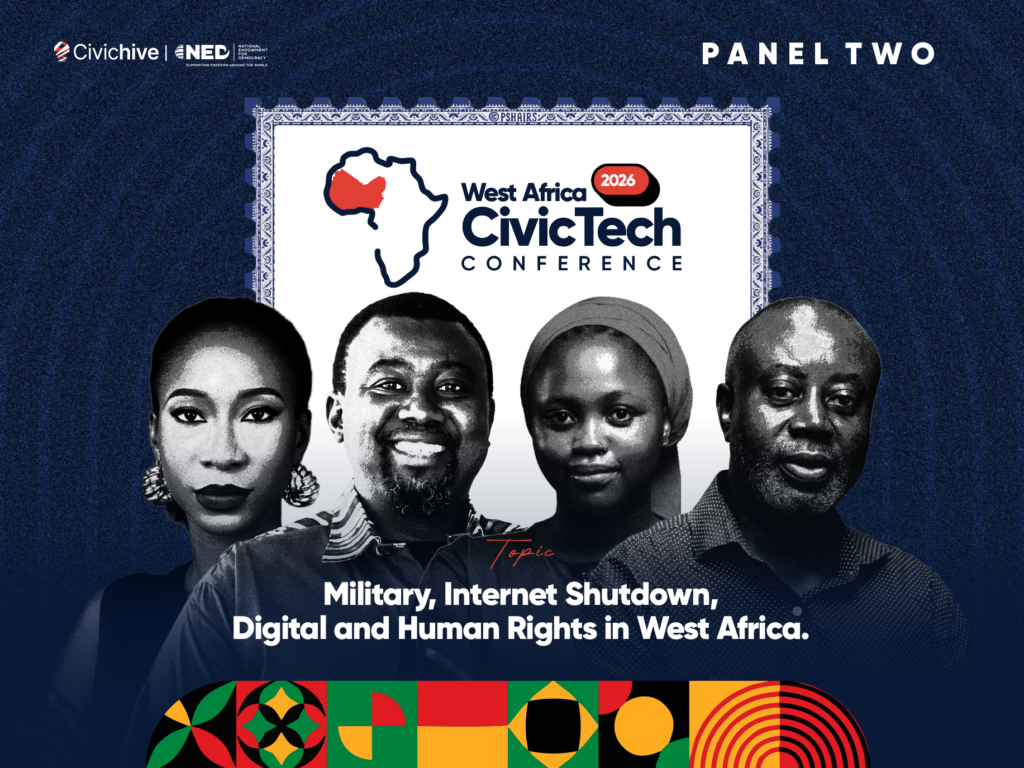
Following the icebreaker, moderator Arafat Oseni (Civic Hive) introduced the panel session titled “Military, Internet Shutdown, Digital and Human Rights in West Africa”.
The panel brought together key perspectives across civil society, public policy, and national security: Gbenga Sesan (Executive Director, Paradigm Initiative), Zulu Anyaogu (Legal Practitioner & Public Policy Expert), and Chido Onumah (Special Advisor to the National Security Advisor on Strategic Communication and Civil Society Liaison).
- Democratic States, Military Habits
Opening the conversation, Gbenga Sesan addressed why internet shutdowns and military-era tactics remain relevant in modern West African democracies. He pointed out that democratic states have retained authoritarian habits from previous military regimes. Where military rulers once seized physical print copies of newspapers like Tell or Newsweek (or bought out entire press runs to suppress stories), modern governments deploy digital censorship tactics.
Dating back to the Abacha era; when authorities attempted to halt online information flows by arresting early ISPs like Linkserve founder Chima Onyekwere, governments have sought ways to control digital communication. Sesan emphasised that online “clickivism” naturally evolves into offline activism and physical protest, pointing to historically significant movements like Occupy Nigeria (2012) and #EndSARS. In response, state controls have grown more sophisticated, progressing from full network blackouts to subnational shutdowns under the guise of counter-terrorism, network throttling, and the unlawful deployment of electronic signal jammers by state officials during public events.

- Vague Legislation vs. International Human Rights Standards
Legal expert, Zulu Anyaogu, highlighted how legitimate security concerns; such as combatting terrorism, cybercrime, or disinformation, are frequently used to justify vague legislative frameworks. Instruments like the Cybercrimes Act, broad media codes, or mandatory journalist registration requirements are increasingly weaponised against human rights defenders, journalists, and civic space.
Zulu stressed that under international legal frameworks (including the ICCPR and the African Charter), any state intervention or surveillance must pass a strict three-part test:
- Legality: Laws must be precise rather than vaguely defined.
- Legitimate Aim: Measures must address explicit threats to public order or national security.
- Proportionality: Interventions must strictly match the threat level; a threshold that indiscriminate signal jamming or blanket internet shutdowns fail to meet.

- Balancing National Security and Civic Freedoms
Representing the Office of the National Security Advisor (ONSA), Chido Onumah articulated the state’s obligation to safeguard lives and property while maintaining citizen trust. Onumah argued that national security should not be viewed narrowly as military force, but holistically; encompassing human security, economic stability, and civic freedoms. He noted that security measures and civic rights are complementary rather than mutually exclusive.
Once immediate security emergencies subside, emergency restrictions should be promptly lifted. To build long-term democratic resilience, government institutions must move away from “mystifying” national security and instead adopt open, transparent communication and legislative co-creation with civil society.
- Pushing Back, Litigation, and Digital Self-Defence
Addressing how citizens can protect themselves while pushing for democratic accountability, Gbenga Sesan urged activists and citizens not to retreat into fear:
- Strategic Litigation: Sesan argued that for democracy to function, “the government must be afraid of the people”. He encouraged citizens to pursue strategic lawsuits against public agencies for rights violations, administrative overreach, and arbitrary road blockades.
- Digital Self-Defence: For online safety, Sesan highlighted open-source resources like Paradigm Initiative’s Ayata toolkit (ayata.africa: from the Yoruba word for “bulletproof”).
- Practical Password Security: He advised users to implement two-factor authentication (2FA) and create resilient passphrases by using spaces, special characters, and local African languages rather than standard English words.
The session concluded with Chido Onumah identifying “Trust” as the single most vital component for a healthy digital governance ecosystem. Establishing trust requires dismantling silos between government, tech platforms, and citizens through continuous dialogue and accountability.