
-
The Lesson of the Unplanned Brief
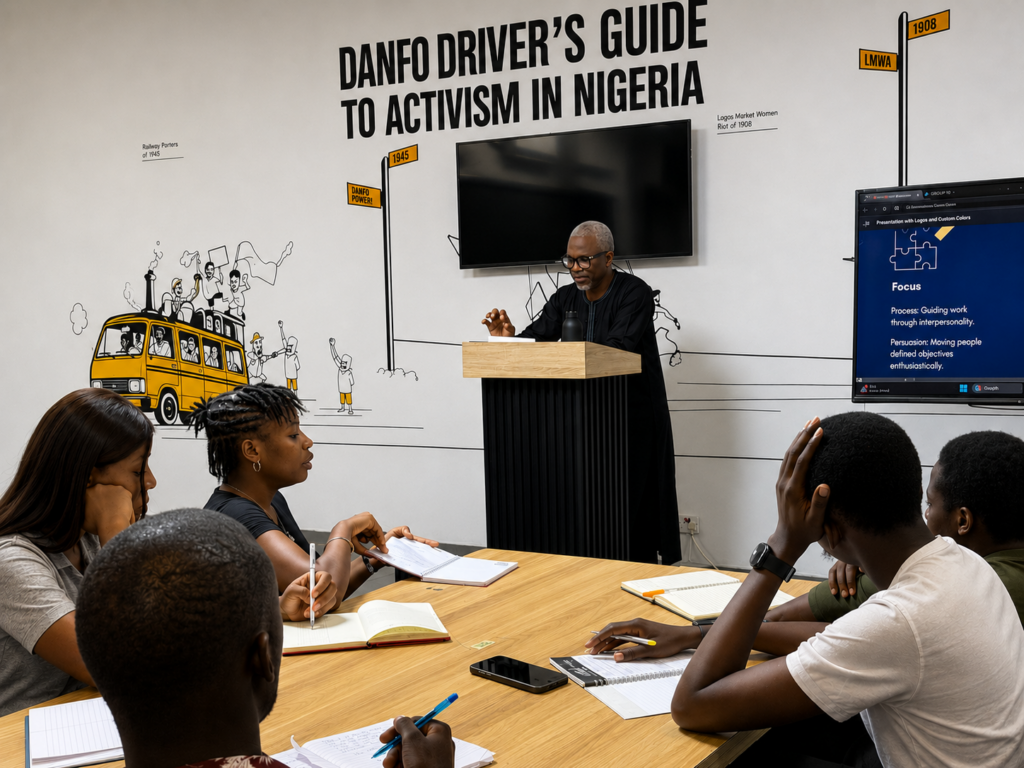
On May 15, 2026, at CivicHive, I was reminded that leadership is rarely found in the comfort of a settled plan; it is forged in the friction of the unexpected. I had arrived that morning under the assumption that I was merely providing brief welcome remarks for the Lagos Youth Development Initiative (LYDI) Cohort 2. Somewhere in the rush of the week, I had missed the core details of the brief shared by my colleague, Temidayo. I discovered, with only ninety minutes to spare, that I was expected to lead a full strategic session.
In the civic sector, adaptability is not a “soft skill”—it is a survival mechanism. This “Early Morning Mix-Up” became the first lesson of the day: even the most seasoned leaders can falter if they lose sight of core details. Yet, the moment also served as a catalyst for a masterclass in team synergy. The “rallying energy” of the CivicHive team was immediate and seamless.
While I pivoted to prepare the content, Yetunde, our Hive Manager, ensured the environment was primed; Arafat transformed raw concepts into a professional visual narrative; Olabisi prepared her lens to document the journey; and Lekan stood ready to welcome our guests with intentionality. This was team cohesion in its most practical form. As the 40 LYDI fellows arrived, the air in the Hive was already thick with the quiet confidence of a team that knows how to pivot in unison.
-
Redefining Leadership: Beyond the Organisational Chart
To view leadership as a static position or a box on an organisational chart is more than an error; it is a strategic risk. In the civic space, we must reject the notion of the “title” and instead embrace the “human factor”—that volatile, essential element that determines whether a nation’s vast resources remain inert or become a transformative force for the common good.
Before engaging the cohort, I sought to clarify their relationship with the Lagos State Government. Understanding that LYDI is duly registered and integral to the state’s youth engagement programs was vital. It established a foundation of psychological safety, confirming that these young leaders are at liberty to organise and speak their minds freely. To navigate Nigeria’s complex sociopolitical landscape, we must move beyond “individual professional excellence” and embody collective efficacy.
This shift is best understood by contrasting the executive process with the persuasive heart of leadership:
| Dimension | Leadership as a Process | Leadership as Persuasion |
| Focus | Guiding and directing work behaviour through active interpersonal guidance. | The ability to move others to seek defined objectives enthusiastically. |
| Mechanism | An executive process of directing others toward specific situational goals. | The “human factor” that binds a group together and motivates pursuit. |
| Foundation | Behavioural shaping toward organisational objectives using intelligence and maturity. | Psychological and emotional engagement that triggers collective action. |
| Outcome | Accomplishment of tasks within a given situational context. | Transformation of a collection of individuals into a unified, motivated force. |
Embodying these definitions requires more than intellectual agreement; it requires a framework that can withstand the intense pressure of the civic arena.

-
The Participative Model and the “Inner Game”
Choosing a leadership style is a calculated strategic move. In the civic sector, where problems are systemic and require deep buy-in, the Participative Leadership model is our primary framework. However, we must be honest about the “Participative Trade-off”:
- Innovation vs. Efficiency: While involving more voices increases creativity and performance, it inherently reduces immediate efficiency. More people means a higher mandate for deliberation and coordination.
- The Information Mandate: For collaboration to be authentic, leaders must invest the time to equip followers with the same information they possess. Anything less is hollow.
- The Risk of Paralysis: Participation takes time. A disciplined leader must possess the situational intelligence to know exactly when to transition from deliberation to decisive execution to meet a mission-critical deadline.
A common question arose: What is the point of participative leadership if the manager already knows the desired outcome? My answer is that denying the group the expressive path to reach a goal is a strategic failure. Even if a leader envisions a destination, the collective must discover the route to truly own the journey.
This “outer game” of management is impossible to win without mastering the “inner game” of self-awareness. Having stood in the Mandela House in Soweto in November 2023, I was struck by how a global movement was birthed from such grounded, collective struggle. From Mandela’s legacy, we derive five prerequisites for the collaborative leader:
- Passion Produces Perseverance: Internal drive is the only fuel that survives a long-term struggle.
- Expect Change to Be Messy: Collaboration is non-linear and often chaotic; we must remain steady in the noise.
- Forgiveness Is Key to Focusing Forward: Grievance is a weight a cohort cannot afford to carry.
- End Right vs. Being Right: We must prioritize the collective outcome over the individual ego.
- Change Begins From Within: Emotional regulation is the foundational requirement for managing others.
Mastering this internal state is what transforms participative decision-making into the engine of Shared Purpose, linking the leader’s internal world to the structural pillars required for a team to survive.
-
The Pillars of Cohesion and the Crisis of Toxic Leadership
Team cohesion is an intentional construct, not a social elective. To prevent performance stalls in high-stakes environments, we rely on four non-negotiable qualities: Vision (conceiving a future others cannot yet see), Empathy (understanding the unique pressures on your peers), Decision-making (the courage to act after the process is complete), and Adaptability (knowing which tool to pull from the belt).
When these pillars crumble, leadership “viruses” take hold. Diagnosing these is a painful but necessary process:
- Mission Subversion: Personal agendas take precedence over “Worthy Goals,” turning the mission into a vanity project.
- Morale Decay: A chaotic environment destroys psychological safety; followers move into a state of pure reaction.
- Performance Stagnation: Productivity evaporates because people will not work hard for leaders they do not trust.
- Loyalty Erosion: Selfish leadership triggers a “talent drain” as high-performers seek healthier waters.
- Ethical Infection: Dishonesty institutionalises corruption, creating a culture of meritless advantage.
- Reputational Suicide: Institutional selfishness eventually destroys the brand, leading to “failed democracies” within the organisation.
The diagnosis of these viruses is often uncomfortable, requiring a safe space where these behaviours can be unlearned and replaced with a culture of service.
-
The Living Laboratory: Vulnerability as a Strategic Asset
Neuroscience confirms that we cannot simply “think” our way out of bad leadership habits. Theoretical study is insufficient; we must engage the brain’s emotional circuits through experiential learning. We treated our session with the six groups of fellows as a “living laboratory,” utilising a strict Session Protocol:
- Identification: Pinpointing moments where leadership emerged through action, not title.
- Analysis: Extracting the specific qualities that made those moments effective.
- Personal Narrative: Sharing stories of failure to build deep trust.
By sharing where their “Inner Game” had faltered, the fellows moved from being mere members of a cohort to a unified force. This vulnerability allowed them to unlearn toxic habits and bridge the gaps that title-based leadership often ignores. These classroom lessons are the micro-foundations for the macro-level challenges facing our nation.
-
Macro Navigation: The Pilot’s Dilemma and the 2027 Inflection Point
Nigeria’s current stagnation—starkly illustrated by our 161st HDI ranking in 2022, compared to Switzerland’s 1st place—is not a crisis of resources. It is a “failure of navigation.” This is the Pilot’s Dilemma: too many people attempt to fly the machinery of state without ever attending “flying school.”
As we look toward the 2027 Strategic Inflection Point, the LYDI cohort must transition from “Professional Excellence” to “Political Stewardship.” This evolution requires a new roadmap:
- The Capability Approach: Viewing development as a tool for expanded human freedom.
- The Abilities Approach: Focusing on empowerment as the primary engine of growth.
- Institutional Insulation: Protecting constitutional values and checks and balances from executive overreach.
This growth is built on four distinct factors: Experiential Learning to trigger behaviour change, influencing ‘being’ through self-awareness, grounding training in Systemic Context, and viewing Faculty as Sherpas who prioritise the group’s emotional safety over their own academic ego.
-
Envisioning the Global Outlook
The energy and brilliance of fellows like Mariam, Esther, Glory, Matemi, Michael, Abdulrasheed, Alausa, Titiloye, Sewande, and Ajoke are a testament to what is possible when we invest in the “human factor.”
The “so what?” of our entire session was clear: we must move from a state of unaccountable superiority to one of purposeful Service.
To the cohort: your journey does not end with this fellowship. Do not feel restricted by local setbacks or systemic challenges. Look beyond the local and subnational; maintain a global outlook for change. Your specific contexts are not barriers, but the very terrain where your leadership must be tested.
Dream big, stay the course, and let the will to keep moving ahead be your hallmark. The training has begun. The aircraft is prepared for takeoff. It is time to lead.