
Interviews and Special Feature with Comfort Usman Kariko – Amplify Youth Initiative (Justice-Net)
- Justice-Net is a tech-powered platform for alternative dispute resolution. What personal experience made you passionate about creating a digital bridge to justice?
My passion for building a digital bridge to justice comes from years of working directly with communities affected by conflict, GBV, and weak justice systems. In many parts of Northern Nigeria where I have worked directly, I’ve seen how simple disputes, the kind that could be resolved in 15 minutes, escalate into violence, arrest, community clashes, or long-term trauma simply because people don’t know where to go for help.
One experience I’ll never forget was a young Woman I met at the Correctional Centre, Goron Dutse, who told me, “Aunty, if there was just one place I could talk to someone without fear, this wouldn’t have gotten this bad.” I heard variations of that same sentence over and over from survivors, from young people, from families torn apart by avoidable conflict. That repeated cry for a safe first step is what planted the seed for Justice-Net.
During the Civic Hive Fellowship, I began prototyping Justice-Net as a digital first-stop for mediation, counselling, and early dispute resolution. But the operational and technical architecture required for a full-scale ADR platform is extensive. Rather than abandoning the idea, we made a strategic decision to build steadily towards a 2026 launch, ensuring the platform is sustainable and community-driven.
In the meantime, the passion didn’t stop. My team at Amplify Youth Initiative developed One Call for Justice, a toll-free, multi-connective tech-enabled GBV and justice support line as an immediate intervention aligned with the larger Justice-Net vision. It allowed us to start bridging access now, while building the long-term backbone Justice-Net will rest on.
At its core, whether through Justice-Net or One Call for Justice, the mission remains the same:
to make justice accessible, early, and non-intimidating, especially for people who have been historically left out of the system.
2. Working with the Kaduna State Peace Commission is a huge step. What’s the most significant lesson you’ve learned about translating a tech idea into government adoption?
One of my biggest lessons is that government adoption is not a straight line; it is a cycle of progress, disruption, and rebuilding.
When I first began engaging the Kaduna State Peace Commission, it felt like we had finally found that institution where building the foundation for digitalising peacebuilding and strengthening early response systems was possible. They understood the value of how technology could mitigate disputes from escalating. We were making real progress.
Then the Commission was dissolved…
Overnight, the structures and relationships we had built disappeared. It was a painful reminder that even impactful work can be disrupted by political changes. But it also taught me something important: if your vision depends solely on one institution, it will not survive.
So we pivoted.
When Amplify Youth Initiative was launching One Call for Justice, our toll-free, multi-connective tech-enabled GBV and justice support solution, these lessons were handy. Despite the earlier setback, the Ministry of Human Services is exploring adopting the system at the state level to combat GBV during the 16 days of Activism.
This taught me three key lessons:
- Build solutions that outlive administrations. Institutional strengthening must be the core, not personalities or political structures.
- Government adoption is built on relationships, not technology alone. You must consistently show up, explain the human impact, and co-create, not impose.
- Flexibility is survival. When one door closes, adapt your entry point. The right institution will eventually align with the work.
In the end, translating a tech idea into government adoption requires patience, resilience, and a willingness to start again when systems shift because the people who need the solution are worth the persistence.
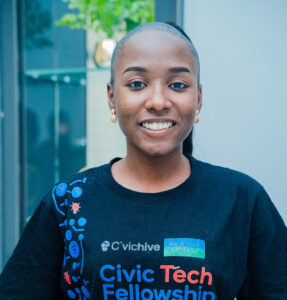
- Since the Civic Tech Fellowship closed out, what are you most proud of achieving with your solution? (Share a specific milestone, a new partnership, or a story of real-world impact that has happened in recent months.)
Honestly, my biggest pride is how far we’ve come from where I started. When I joined the Civic Hive Fellowship, all I had was my legal background; I didn’t have a technical background, I didn’t understand product development deeply, and I had never built a civic-tech solution before. The fellowship was my first real learning ground for civic technology. It gave me language, tools, mentors, and confidence to move from “I have an idea” to “I can build this.”
That foundation is what made everything that followed possible. What I’m most proud of is that even though Justice-Net is still in development, we didn’t wait for the “perfect version” before creating real impact; we built what we could with what we had.
The biggest milestone has been launching One Call for Justice, a toll-free, multi-connective tech-enabled GBV and justice support line that serves as a practical stepping stone toward the full Justice-Net platform. It has already become a safe entry point for survivors who would otherwise stay silent because they fear the police, stigma, or retaliation.
That is when a survivor calls; they are not just speaking into a void, they are connected directly to a coordinated network of at least five First Responders, including psychosocial support providers from the SARC Centre, legal aid, law enforcement desks, and medical services. Another major moment was the official partnership process with the Kaduna State Ministry of Human Services & Social Development, which is now exploring state-level adoption of the solution ahead of the 16 days of activism for GBV.
For me, that is the kind of system strengthening we always dreamed of.
So yes, the partnerships matter, the tech matters, but what I’m most proud of is this: a solution that started as my first civic-tech experiment during the fellowship is now helping real people find safety and justice.

- Looking ahead, what does the next chapter look like for your initiative?
Strategically, the next chapter is about moving from pilots to institutionalised, scalable systems that strengthen access to justice across communities.
First, we are launching Justice-Net in 2026 as a full ADR infrastructure, not just a platform. We are transitioning from prototyping to building the technical and operational backbone of a digital dispute-resolution ecosystem. This includes case-routing logic, mediator networks, user verification models, and integration pathways with existing state mechanisms. The long-term plan is for Justice-Net to serve as a preventive security tool, resolving disputes before they escalate into violence.
Second, we are scaling One Call for Justice as a state-backed reporting and referral system. With the ongoing state adoption process, our focus is to embed the line within the other state’s GBV response architecture. This involves strengthening partnerships with shelters, police desks, counsellors, and legal services so that survivors are connected to real support within minutes, not days. Our 2025 goal is to expand coverage to rural States and integrate SMS/USSD pathways for low-connectivity areas.
And finally, we’re investing in people.
Technology alone cannot resolve disputes; people do, so scaling the people side is just as important as scaling the tech. We are developing a structured pipeline for training mediators, paralegals, counsellors, and first responders who will power both Justice-Net and One Call for Justice. This includes a capacity-building model, digital ID for mediators, and a monitoring system for quality assurance.
In simple terms, our next chapter is about institutionalization, scale, and sustainability. We are building systems that will outlive projects, personalities, and political cycles, systems that make justice accessible, predictable, and preventive for the average citizen.
Quick Fire Round:
Quick-fire rounds. Shall we?
Let’s do it.
Policy Reform or Grassroots Action?
Grassroots action. Policies matter, but real change begins with the people directly affected. When communities move, policies follow. That’s where the truth lives, where the data comes from, and where solutions are tested before they ever reach a policy desk.
Code or Community?
Code. Because scalable solutions need strong foundations, Community inspires us, but code helps us build for everyone.
Dream Collab?