
As Africa enters 2026, the continent once again stands at a critical democratic crossroads. From East Africa to West and Southern Africa, several countries are heading to the polls in what will be a defining year for governance, civic participation, and political accountability. Elections in Africa have increasingly become moments of both possibility and tension testing institutions, civic space, electoral credibility, and citizen trust.
The year opens with Uganda’s just concluded general elections, setting the tone for what many observers expect to be a politically charged year. Across Africa, elections in 2026 will unfold amid rising youth populations, shrinking civic spaces in some regions, economic pressures, climate challenges, and increasing use and restriction of digital tools during electoral processes.
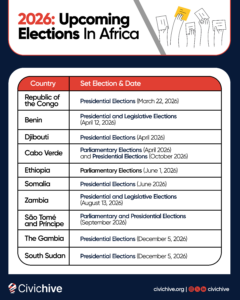
In 2026, presidential and legislative elections are scheduled across at least 11 African countries, including Uganda, Benin, Zambia, Ethiopia, The Gambia, and South Sudan. In addition, several countries will also hold legislative elections, reinforcing the central role of parliaments in democratic governance. How these elections are conducted and how citizens are allowed to participate will shape Africa’s democratic trajectory for years to come.
January 2026: Uganda Presidential elections
Uganda, often referred to as the “Pearl of Africa”, is a landlocked East African country known for its rich cultural diversity with over 56 ethnic groups, and as the source of the River Nile. Bordered by Kenya, South Sudan, the Democratic Republic of Congo, Rwanda, and Tanzania, Uganda plays a significant role in regional politics within the African Great Lakes region. As of 2024, the country’s population stood at nearly 49.3 million, with approximately 8.5 million residents in Kampala, the capital and largest city.
Uganda operates a presidential system where the president serves as both head of state and head of government, supported by a vice president and a prime minister. The country’s political landscape has, however, been dominated for decades by one man, President Yoweri Museveni, who has been in power since 1986.
- Electoral System and Participation
Uganda’s president is elected using a two-round system, requiring a candidate to secure at least 50% + 1 of the vote to win outright. Parliamentary elections follow a mixed structure, with 529 seats, including constituency representatives, reserved seats for women, and special interest groups such as youth, workers, persons with disabilities, and the military.
Despite the structured electoral framework, Uganda continues to face persistent challenges around press freedom, opposition repression, and the use of security forces during elections, factors that significantly affect public trust in democratic processes.
- Political Context and Power Dynamics
The 2026 elections once again saw President Museveni, now 81 years old, extend his rule after constitutional term limits were removed in 2005 and age limits lifted in 2017. His continued hold on power has raised long-standing concerns around democratic consolidation, leadership succession, and political pluralism in Uganda.
Museveni’s latest campaign has also been closely linked to the growing political profile of his son, Muhoozi Kainerugaba, the Chief of Defence Forces. His rapid promotions within the military and increasing public visibility have fueled speculation about a possible hereditary succession, a concern that has drawn criticism both domestically and internationally.
- Election Results and Controversies
According to Uganda’s Electoral Commission, Museveni was declared winner of the presidential election with 72% of the vote, while his closest challenger, Robert Kyagulanyi Ssentamu (Bobi Wine) of the National Unity Platform, secured 25%. Bobi Wine rejected the results, alleging ballot stuffing and irregularities, though African Union observers reported no direct evidence of ballot manipulation.
| UGANDA 2026 ELECTIONS RESULTS | ||
|---|---|---|
| Candidate | Political Parties | Votes |
| Yoweri Kaguta Museveni | NRM | 7,946,772 |
| Mugisha Muntu | ANT | 59,276 |
| Robert Kyagulanyi | NUP | 2,741,238 |
| Nandala Mafari Nathan | FDC | 20,939 |
| Munyagwa Mubarak | CMP | 31,666 |
| Joseph Mabirizi | CP | 23,458 |
| Robert Kasibante | NPP | 33,440 |
| Bulira Frank Kabinga | RPP | 45,959 |
| Total No of Invalid Votes | 275,353 | 2.42% of Vote Cast |
| Total No of Votes Cast | 11,366,201 | 52.50% of Registered voters |
The announcement of results was followed by an atmosphere of tension rather than celebration. Kampala witnessed empty streets, closed businesses, and reports of isolated violence in some neighbourhoods. Compounding concerns was the nationwide internet shutdown, imposed days before the election. Authorities justified the blackout as a measure against misinformation and violence, while the UN Human Rights Office condemned it as “deeply worrying.”
Conclusion: Democracy at a Crossroads
As 2026 unfolds, elections across Africa will not only determine who holds political power but also reflect the state of democratic resilience on the continent. Uganda’s elections highlight enduring tensions between stability and reform, control and participation, authority and accountability. Similar questions will echo across other African nations heading to the polls.
For citizens, civil society, and civic tech innovators, 2026 presents both challenges and opportunities to protect civic space, demand transparency, and ensure elections remain a genuine expression of the people’s will. As history has shown, elections alone do not define democracy, but how they are conducted and how citizens are allowed to engage certainly do.