
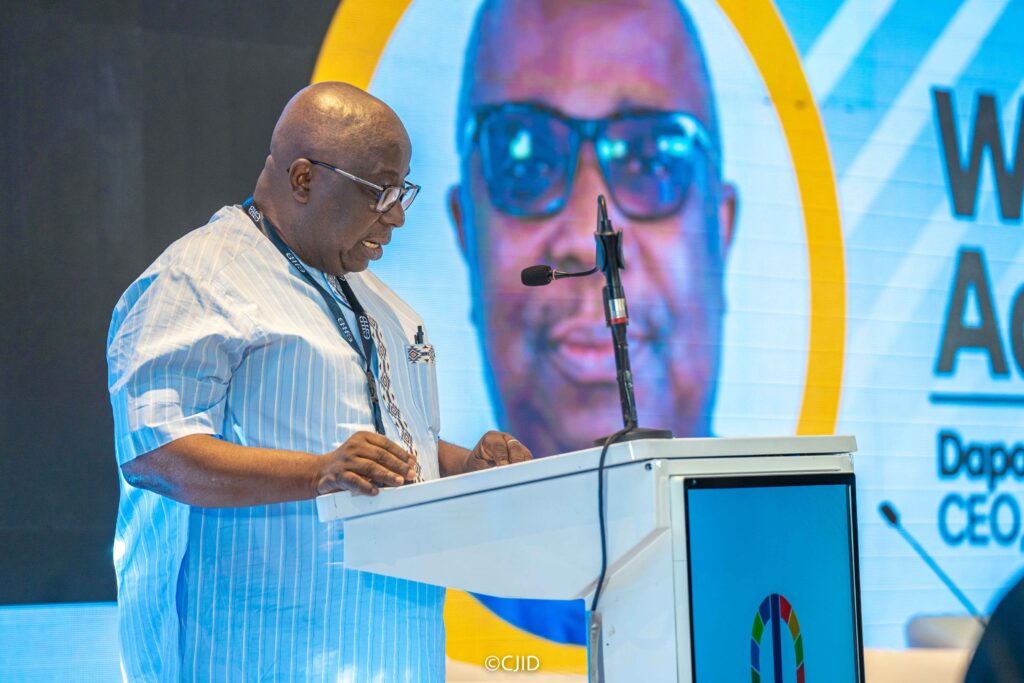
Joining Civic Hive meant becoming part of a community dedicated to strengthening participatory democracy in Nigeria, a place where youth are empowered as active shapers, not just observers, of their daily lives. However, the 2025 Media & Development Conference, hosted by the Centre for Journalism Innovation and Development (CJID), held over three days from November 24th to 26th, offered a truly profound experience that deepened this commitment beyond expectation. It was a space where, for me, ideas converged, visions were shared, and the critical questions surrounding Africa’s democratic future were met with honest, intense discussion.
My experience at the conference was not just professional; it was personal. It forced me to confront the gains we have made in civil society, the dangerous regressions we continue to witness, and the immense responsibility we carry as a new generation of civic actors.
- Democracy, Data, and the Human Story Behind Numbers
The keynote address by Juana Kweitel, Vice President and Chief Programmes Officer at Luminate, felt like a mirror. She spoke about democracy not as an abstract ideal, but as a system made vulnerable by how we treat people both offline and online. Her statistics were disturbing: “28% of Kenyan women report online violence while 82% of women in parliament receive digital threats.” It struck me that the digital world, which civil society often praises as an equaliser, can also become a battlefield.
Juana emphasized the need to invest in media and democracy work not as one-off grants, but as long-term commitments. That message resonated deeply, especially now that we stand in a world where USAID and other international donors are freezing or reducing funding, forcing us to ask: What happens when the world’s largest democracy-building donors tighten their taps? Nigeria cannot depend indefinitely on foreign aid. The sustainability of our work in civic tech, governance advocacy, and accountability must come from local philanthropy, domestic funding ecosystems, and institutions that trust us enough to invest in long-term change.

- When Brazil Meets Nigeria: Shared Struggles, Shared Possibilities
The fireside chat following her keynote explored parallels between Brazil and Nigeria. Both nations battle with connectivity gaps, misinformation, political polarisation, and the consequences of digital monoculture, where one solution is forced onto many problems.
The question that lingered for me was “How do we protect people online without suppressing free expression?” Countries like Brazil are considering laws on misinformation. In Nigeria, the temptation for digital authoritarianism often hides beneath “regulation.” Striking this balance between protection and control may be one of the hardest political tasks of the next decade.
- ECOWAS at 50: A Region Searching for Itself
The first plenary session, moderated by Sefa Ikpa, brought together Mina Mensah, Dr. Chukwuemeka B. Eze, Mathew Ayibakuro, and Stanley Achonu to interrogate the future of democracy in West Africa.. Panelists like Dr. Chukwuemeka B. Eze and Stanley Achonu did not mince words. Dr. Eze reminded us that “We pretend the military regime exists in isolation, but its resurgence is tied to unresolved influence”. It became clear: West Africa is not just experiencing democratic decline; it is confronting an identity crisis.

Citizens feel abandoned, poverty deepens, elections are contested, and coups are resurfacing. ECOWAS, the body designed to safeguard regional peace uses “regulations and policies” to govern rather than recognizing that they are unresolved historical influence from external oppressors. For ECOWAS to matter in the next 50 years, it must reclaim its autonomy, strengthen financial independence, and finally lead with African-centred solutions.
Civic Hive’s work suddenly felt even more significant. Our focus on political education, citizen empowerment, and governance reform sits at the heart of rebuilding legitimacy, one community at a time.
- Youth on the Frontline: Reclaiming the Future
One of my favourite sessions was Plenary Session 3 on youth participation. It was honest and unfiltered. Figures like Faith E. Onyebujoh, Samson Itodo, and Moremi Ojudu spoke passionately about the growing apathy among young Nigerians.
Hon. Abdoulie Njai captured it best: “Young people don’t want to be accessories in politics, they want real power.” As someone who works daily with creatives, students, and civic innovators, I understood this deeply. Young people are not running away from participatory democracy; they are running away from broken systems that refuse to accommodate their voices. If democracy is to survive in Africa, we must rebuild trust, not with slogans, but with results.
- AI, Data, and the Next Frontier of Development
The CJID AI Summit on Day 3 introduced a new chapter in my understanding of development work. As a communications and programs enthusiast, I have always known that data is essential. But this summit showed me something deeper: Data is not just information, data is power. The power to shape narratives, drive policy, and expose injustice.
Tools like TruthNet, SourceMap, and Newsbridge developed by CJID’s AI Fellows, demonstrated how artificial intelligence can strengthen investigative journalism, track misinformation, and protect information from digital manipulation.

A closing reflection from the summit is that Africa cannot afford to rely solely on foreign-built AI systems that do not understand our context, culture, or complexities. If we fail to build our own data governance frameworks and indigenous AI tools, we will become digitally dependent in ways far worse than economic dependency.
AI is not the future, it is the present. And civil society must learn to use it ethically, strategically, and courageously.
- An Evening of Hope: Celebrating Young Journalists
The final night concluded with the Excellence in Journalism Awards Dinner, celebrating student journalists working on fact-checking, women-focused stories, and community reporting. Watching them walk up the stage made me hopeful. Their courage reminded me that journalism despite intimidation, shrinking civic space, and economic hardship remains one of Africa’s strongest lines of defense against oppression. Their stories reminded me why Civic Hive invests so heavily in political education, open governance, and civic capacity building. Democracy survives only when people are willing to defend it.
As I left the conference, one thought stayed with me: 2030 is not just another year, it is a deadline, marking the expiration of the Sustainable Development Goals, a turning point for global development funding models, a moment when Africa’s population will surge past 1 billion youth, and a time by which AI adoption is poised to reshape governance structures across the continent.
By 2030 and beyond, countries like Nigeria must choose who they want to become:
- A nation dependent on foreign donors or one powered by strong local philanthropy
- A country where data is weaponized or where data fuels development
- A state where youth are spectators or leaders
- A society where accountability is optional or a cultural norms
The next decade will determine whether Nigeria emerges stronger or slips further into democratic fragility. As someone nurtured within Civic Hive’s ecosystem of innovation and active citizenship, the conference reaffirmed that participatory democracy is not a theory, it is a discipline. One that requires work, consistency, courage, and imagination and that democracy, development, and technology cannot exist individually. They must be reimagined together, with people at the centre.
And as we move toward 2030 and beyond, I am more convinced than ever that our future will be defined not by what we inherited, but by what we choose to build. As I return to my work in civic tech and communications, I carry with me the urgency and optimism of these three days, and the reminder that collaboration is not optional. It is the only path forward.