
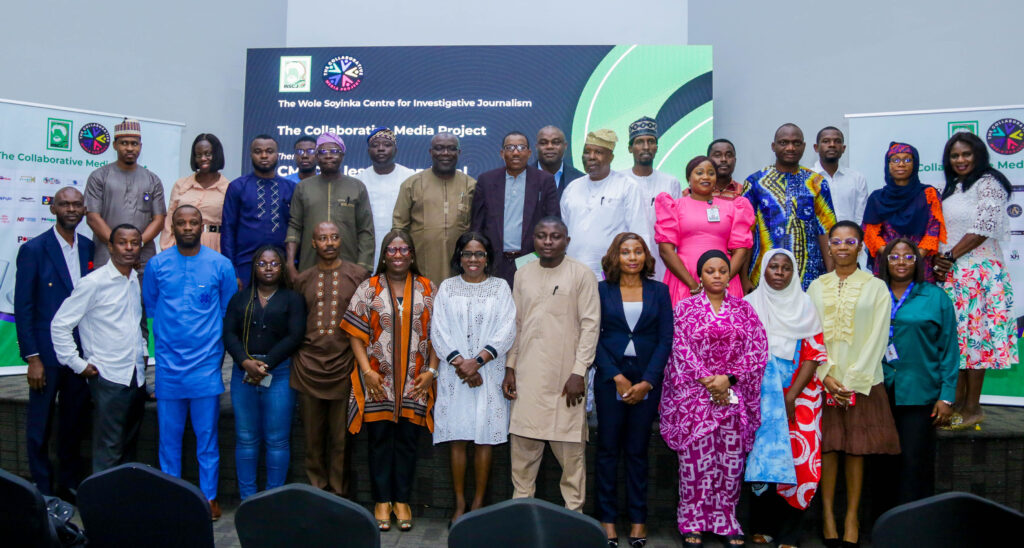
On Tuesday, 28th of October, the Wole Soyinka Centre for Investigative Journalism Wole Soyinka Centre for Investigative Journalism (WSCIJ) hosted an event that brought together journalists, media innovators, and civic actors to reflect on the future of journalism, accountability, and the protection of civic space in Nigeria. The event also marked the launch of the 3rd edition of the “Shrinking Freedoms” Journalism and Civic Space Status Report (2024), a timely exploration of the realities journalists face as they continue to safeguard democracy and amplify citizens’ voices.
Reimagining the Role of the Media in Public Service
In her powerful keynote, Motunrayo Alaka, Executive Director of WSCIJ, highlighted a central concern, the capture of state media by political power. “What we have at many levels,” she noted, “is state service media, not public service media. We should have stations like NTA operating in the interest of the public, not the government in power.”
Her remarks underlined a fundamental principle of democratic governance: media must serve as a public trust, not as a tool of political convenience. According to Alaka, true public service media should amplify diverse voices, especially those at the grassroots who are often excluded from mainstream narratives.
Collaborative Journalism for Subnational Accountability
The event also showcased the Collaborative Media Project , an ambitious initiative that brought together 26 media organizations across Nigeria. Supported by the MacArthur Foundation, the project focused on strengthening local media institutions, fostering collaboration, and bridging the gap between citizens and policymakers.
Over the course of three years, the project achieved remarkable results:
- $3.1 million invested in local and collaborative journalism,
- 3,790 journalists trained across Nigeria,
- 1,105 mass communication students mentored,
- 844 stories published on subnational accountability,
- 17 media organizations structurally strengthened.
These outcomes reflect the resilience of Nigeria’s media ecosystem and its evolving role in normalizing accountability across governance, business, and civil society.
It was important to build the capacity of local media organizations, ensuring that their work thrives beyond donor cycles…this is how we sustain accountability at the subnational level.

The Shrinking Freedoms Report: Journalism in a Restricted Civic Space
The 2025 Shrinking Freedoms Report paints a sobering picture of the challenges journalists face in Nigeria’s democratic landscape. The findings show that the state remains the biggest violator of media freedom, responsible for 81 out of 103 recorded cases of repression, 53 of which were linked to the police.
These violations often occur in spaces where democratic expression is most visible, during protests, elections, and political gatherings. As the report notes, journalists remain the “guards of the civic space”, bearing the responsibility of holding power accountable even amid intimidation.
Charging the Future: Local, Collaborative, and Digital
Looking ahead, WSCIJ envisions a future of journalism that is local, collaborative, and digital-first. The call is clear: journalists, media houses, and civic actors must build networks of collaboration rather than working in isolation.
You can’t stand alone,” Alaka reminded participants. “To survive and remain impactful, you must be part of a network.
As technology reshapes media practice, this collaborative ethos aligns closely with Civic Hive’s mission, empowering citizens, innovators, and civic organizations to use data, storytelling, and technology to deepen accountability and civic participation. The event is a reaffirmation of the vital role of the media in sustaining Nigeria’s democracy. Through sustained collaboration, investment in local journalism, and protection of civic freedoms, the vision of a thriving, accountable, and inclusive Nigeria remains within reach.